
In Berlin-Brandenburg, a surgical team prepares for an operation. The biodegradable sutures they’re using were once a nurse’s uniform. In a nearby greenhouse, plants are thriving with biofertilizers made from contaminated cleaning cloths that have been cleaned and decomposed. Along the coast, erosion-control structures built from this same textile waste protect shorelines while also safely biodegrading over time.
This isn’t science fiction. It’s the vision taking shape at the Beneficial Design Institute’s Nature of Fashion pilot in Germany, where textile waste transforms into materials that serve multiple industries before safely returning to the Earth again.
The 10% Nobody Wants to Talk About
While the circular fashion movement celebrates fiber-to-fiber recycling and secondhand markets, there’s a category of textiles everyone quietly ignores: the “stubborn 10%.” These are contaminated workwear, mixed polyester-cotton blends, elastane-heavy activewear, and chemically treated industrial cloths that conventional recycling cannot process.
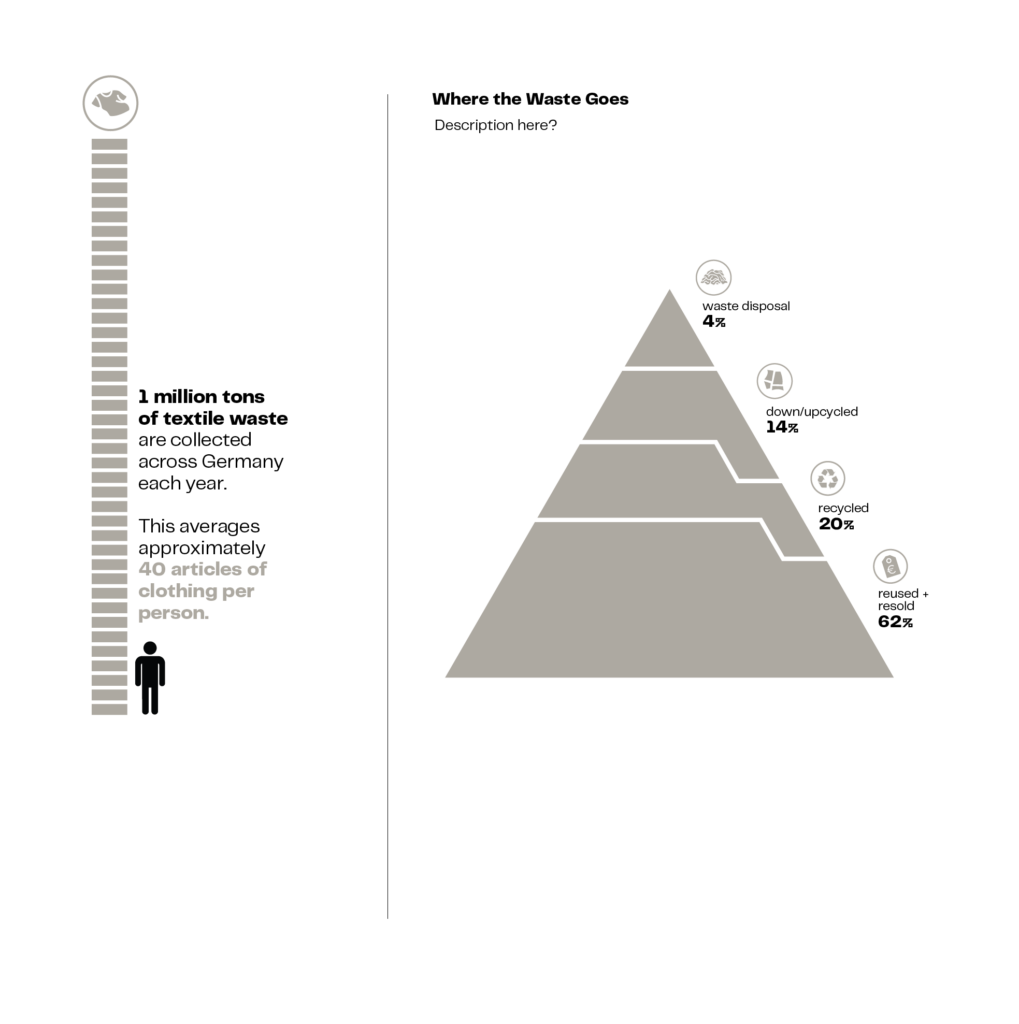
Germany collects approximately 1 million tons of textile waste annually1, yet 54,000 tons2 still burn in incinerators each year. Thousands more get exported to Global South nations, flooding local markets and ecosystems with waste that was “too difficult” for European infrastructure.
Fiber-to-fiber recycling requires materials that are at least 95% pure. But the reality of global fashion production is blends: cotton-polyester for durability, wool-acrylic for warmth, elastane-nylon for stretch. Add contamination from dyes, finishes, and industrial use, and less than 1% of global textile waste actually gets recycled back into textiles3.
For this stubborn fraction, incineration has been the default answer for decades. Until now.
Nature’s Answer: Transform, Don’t Just Recycle
The Berlin-Brandenburg pilot’s breakthrough lies in a simple observation:
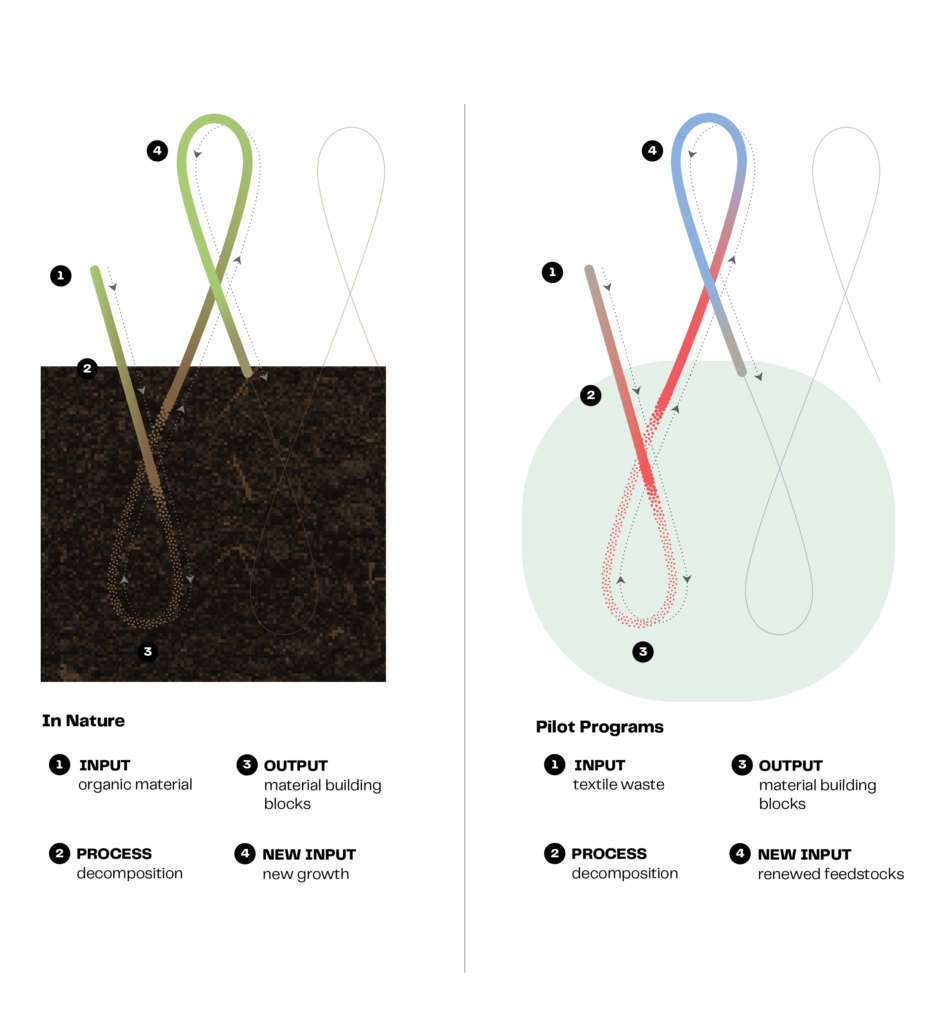
Nature doesn’t recycle materials into the same things—it transforms them.
Fallen trees don’t have to become trees again; they become soil, fungi, beetles, birds. Every ending fuels different beginnings.
Led by Beneficial Design Institute in partnership with Fraunhofer IAP, matterr GmbH, and Fraunhofer IGB, the pilot tests two complementary pathways inspired by how nature decomposes and rebuilds:
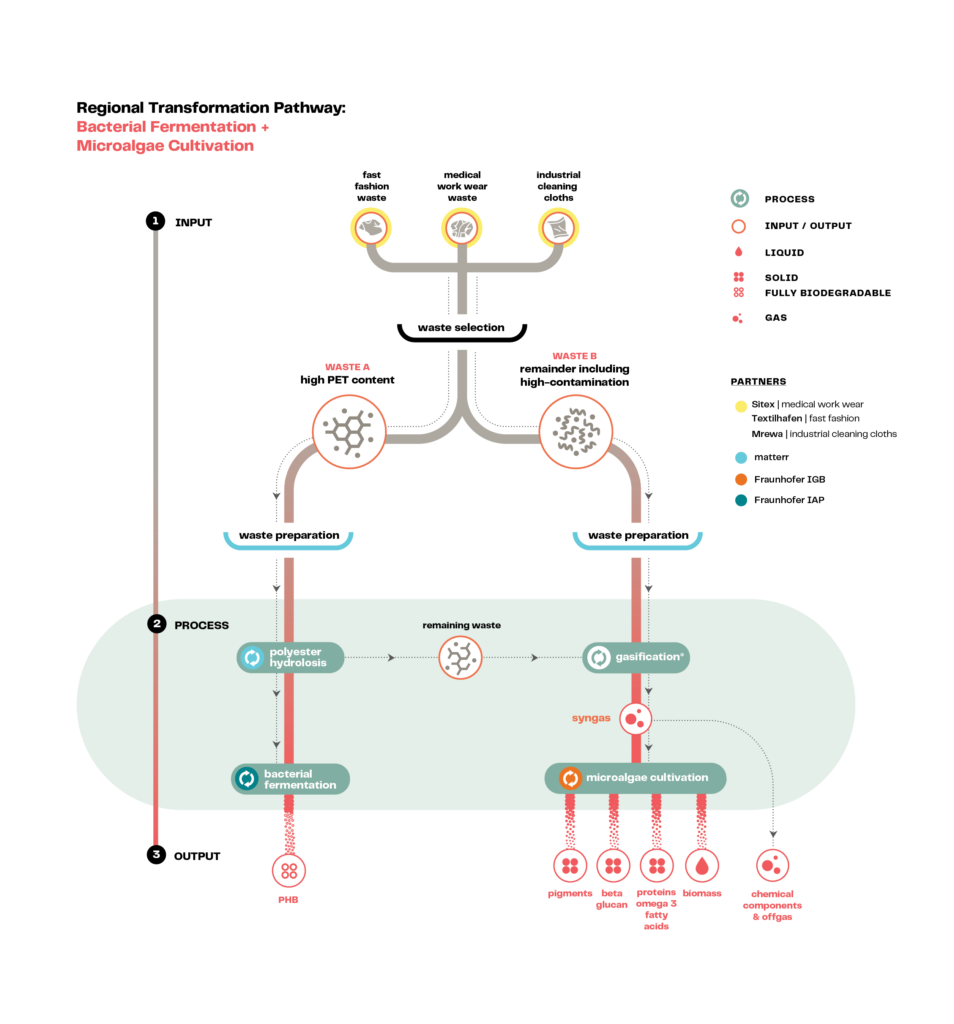
Pathway 1: From Polyester Waste to Biodegradable Materials
Polyester-rich textiles undergo a biochemical process that breaks them down into their basic building blocks. These building blocks then feed specialized bacteria, which convert them into PHB (polyhydroxybutyrate), a bio-plastic which is fully biodegradable, safely breaking down in soil, water, and even the human body.
All 18 types of textile waste tested—from medical workwear to fast fashion—could be successfully transformed. Early results show this process achieves 60 to 99% lower carbon emissions compared to making conventional plastics from fossil fuels.
Pathway 2: From Mixed Waste to Agricultural Solutions
For textiles too mixed or contaminated for the first pathway, a second approach envisions using gasification to convert them into carbon-rich gas. Microalgae then use that gas to grow and produce beta-glucan, a glucose-rich compound valuable for agriculture as biofertilizers and plant stimulants.
Together, these pathways show how even “impossible” waste can be transformed to become valuable resources for multiple industries.
Cross-Industry Transformation: One Waste Stream, Many Solutions
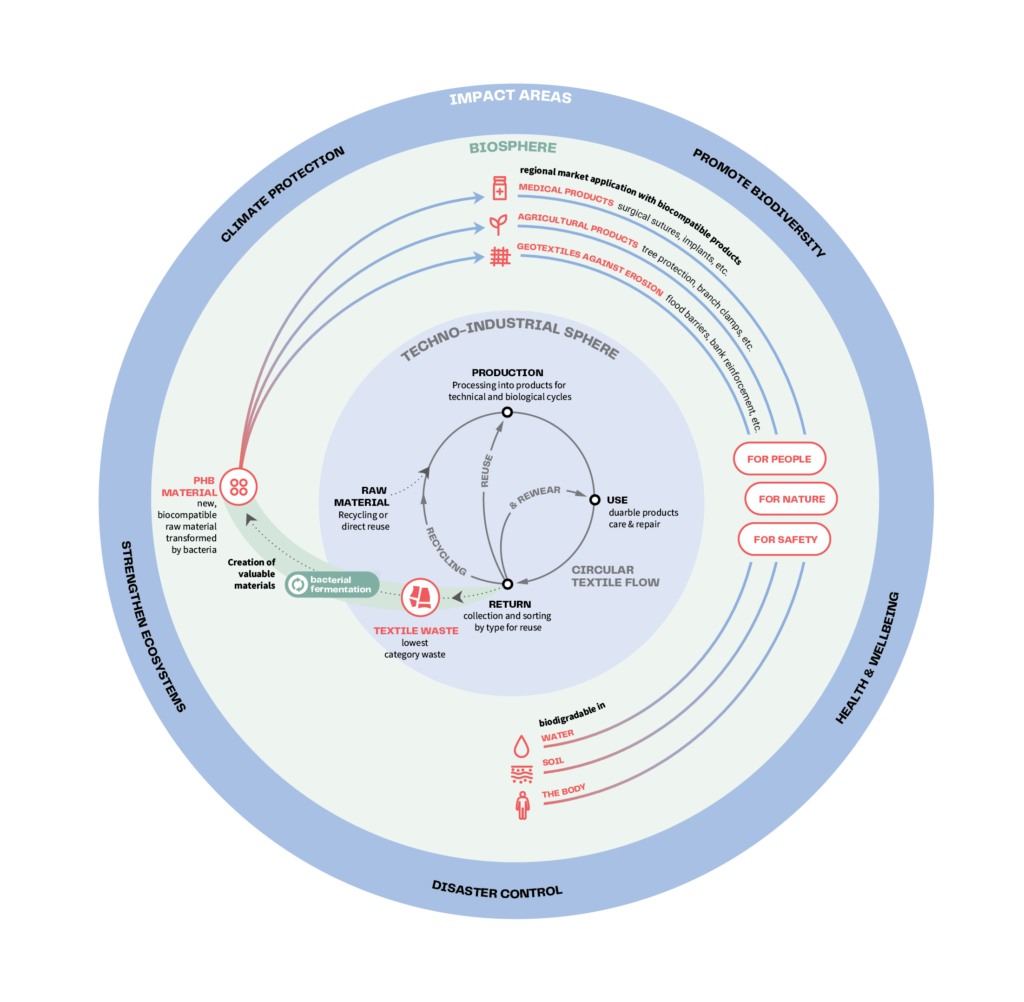
The pilot’s most compelling opportunity lies in its versatility. Materials from textile waste could serve multiple high-value markets:
Medicine: Resorbable bone screws, sutures, pill capsules, and surgical instruments. The narrative is powerful: medical textiles become medical materials—a complete closed loop that resonates with institutional partners and funders.
Agriculture & Forestry: Biodegradable tree clips, erosion-control geotextiles, biostimulants, and biofertilizers that improve soil health without leaving microplastic residue.
Environmental Protection: Shore protection structures, artificial breakwaters, and biodegradable urns and coffins for funeral services—all applications where materials safely return to nature rather than requiring retrieval.
This cross-sector approach creates resilient business models that are less dependent on single markets, while demonstrating nature’s principle that waste from one system becomes nutrients for many others.
Regional Value Creation as Strategy
Unlike pilots focused solely on proving technology works, Berlin-Brandenburg emphasizes regional economic development. Brandenburg already hosts 250 biotechnology firms, deep circular economy expertise, and established textile infrastructure. The pilot positions this region as a textile transformation hub by:
- Shortening supply chains through local processing
- Creating green manufacturing jobs in bioplastics and biomaterials
- Building partnerships between research institutions, industry, and textile service providers
- Establishing infrastructure for tracking textile waste from procurement forward
The strategy focuses on business-to-business textile waste as the foundation: medical workwear from hospitals, industrial cleaning cloths, uniforms. Unlike chaotic fast fashion bins filled with 50 different fiber blends in 50 different conditions, B2B textiles are predictable, traceable, and consistent—perfect for validating technology before expanding to more complex waste streams.
The Path Forward
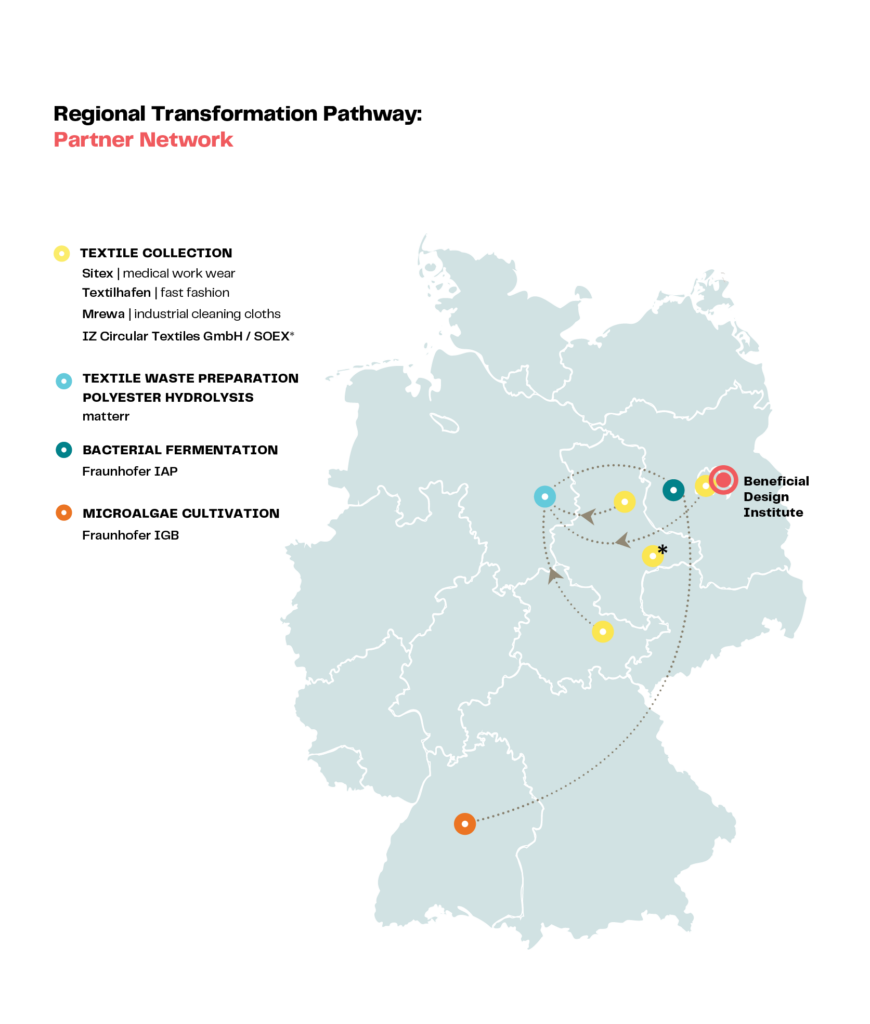
The pilot is advancing from laboratory validation toward pilot-scale demonstration over the next two to three years. If successful, the Berlin-Brandenburg region could process thousands of tons of textile waste annually that would otherwise burn or be exported. This would create hundreds of local jobs while supplying biodegradable materials to medicine, agriculture, and environmental protection industries.
But this scaling faces a distinctly German challenge: fragmented funding structures that favor single-technology research over integrated systems. The team has built cross-border collaboration—drawing on gasification data from the Netherlands pilot—to prove concepts that German funding alone couldn’t support.
The lesson: transformation requires systems thinking not just in technology, but in policy and investment.
A Different Kind of Transformation Story
The Beneficial Design Institute isn’t trying to recycle fashion back into fashion. It’s transforming textiles into something entirely different: materials that safely biodegrade in the human body, in soil, in water. Materials that eliminate the need for retrieval systems because they become nutrients, not pollutants.
This challenges the assumption that circularity means closed loops. Sometimes transformation means opening new pathways, where waste from one industry becomes feedstock for another, where the end of a garment’s life marks the beginning of a medical device, a biofertilizer, a shore protection structure.
Nature operates this way. The Berlin-Brandenburg pilot proves we can design industrial systems with the same logic.
Medical scrubs become surgical implants. Cleaning cloths become agricultural nutrients. Fast fashion becomes forestry materials. The stubborn 10% that the circular economy abandoned becomes the foundation for regional regeneration across industries.
The technology works. The partnerships are forming. The infrastructure is emerging. What remains is funding alignment, policy courage, and the willingness to see textile waste not as a problem to manage, but as a resource to transform.
Berlin-Brandenburg is showing what’s possible. Now it’s a question of scale, speed, and systems-level commitment.Follow @biomimicyinstitute for more innovation news of the Nature of Fashion initiative.
The Nature of Fashion: Design for Transformation is led by the Biomimicry Institute and funded by Laudes Foundation. The Berlin–Brandenburg pilot implemented by Beneficial Design Institute in collaboration with Fraunhofer IAP, Fraunhofer IGB, matterr GmbH, Regenerate Fashion, and regional industry partners. Learn more at https://biomimicry.org/innovation/nature-of-fashion/ and d4t.biomimicry.org
1. Federal Ministry for the Environment, Nature Conservation, Nuclear Safety and Consumer Protection. (2025). Clothing and textiles. https://www.kreislaufwirtschaft-deutschland.de/en/the-national-circular-economy-strategy-nces/action-areas/clothing-and-textiles
2. European Environment Agency. (2025). Share of textile waste sent to incineration or landfill in the EU. https://www.eea.europa.eu/en/circularity/sectoral-modules/textiles/share-of-textile-waste-sent-to-incineration-or-landfill-in-the-eu
3. Ellen MacArthur Foundation. (2017). A new textiles economy: Redesigning fashion’s future. https://content.ellenmacarthurfoundation.org/m/6d5071bb8a5f05a2/original/A-New-Textiles-Economy-Redesigning-fashions-future.pdf