A collaboration between the Biomimicry Institute and The Microfibre Consortium
Imagine a garment designed to give everything it has and then quietly return. At the end of its useful life, its fibres break down safely, its materials cycle back into something new, and the ecological systems around it continue to function, undisturbed. This is not a distant fantasy. It is the principle that animates every forest, every estuary, every living system on the planet. And it is what the fashion industry, despite significant momentum toward circularity, has not yet achieved.
Over the past decade, the industry has made meaningful progress. Brands have committed to recycled content targets. New fiber-to-fiber technologies have demonstrated commercial viability. Extended producer responsibility frameworks are tightening across Europe and beyond. The direction of travel is right. But a closer look at what happens to textiles after they leave our hands reveals a gap that the current circular economy model has not yet addressed. Two organizations, working from different vantage points, are finding the same thing.
The Part We Cannot See
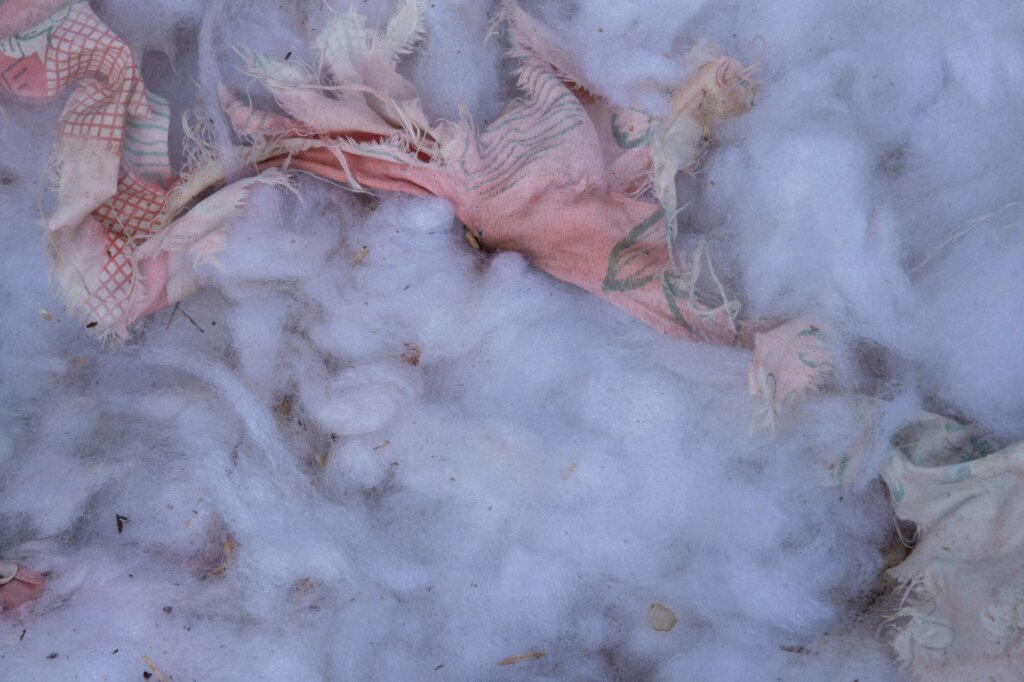
The Microfibre Consortium (TMC) has spent years building the science of what happens to fibres fragmenting into the environment. The findings are striking, and in some cases counterintuitive. Fibre fragmentation does not stop when a garment is disposed of. Textiles that end up in landfill, littered environments, or industrial composting facilities continue to shed fragments into terrestrial and aquatic systems. Those fragments, as documented in academic studies and synthesised in TMC and Fashion For Good’s Behind the Break report, can affect soil properties, microbial communities, and aquatic organisms. They travel through groundwater. They move via run-off into water bodies. They persist.
What makes this particularly significant is which fibres are involved. Research published in 2026 on lake sediment samples spanning 150 years has documented the long-term persistence of fibres across all types in natural environments. This is not a synthetic-only story. The historical focus in microfibre research on synthetic materials and laundry emissions, while important, has left a significant blind spot around natural fibres and end-of-use pathways. As Kelly Sheridan, CEO at the Microfibre Consortium, puts it: “There is increasing and undeniable evidence that fibre persistence in the environment is not limited to synthetics. The challenge is broader than one fibre type or one source pathway. To date, much of the conversation has focused on synthetic fibre fragments released during use and through laundering, but we need to better understand what happens to all fibre types at end of use, and how they behave and persist once they enter natural environments.”
The implication is that “natural” is not the same as “safe to return to the environment,” particularly once a fibre has been processed, dyed, blended, or chemically treated. This distinction matters enormously, and it connects directly to work happening at the other end of the textile lifecycle.
The Fraction the System Cannot Handle
The Nature of Fashion: Design for Transformation initiative, led by the Biomimicry Institute and funded by Laudes Foundation, works on a different question: what do we do with the textiles that circularity has given up on? Across its pilot projects in the Netherlands and Germany, the initiative has been working on exactly the waste fraction that conventional recycling cannot address.
Fiber-to-fiber recycling, the dominant paradigm in circular textiles today, requires materials that are relatively homogeneous and free of contamination. In practice, the majority of global textile production does not meet those criteria. Garments are designed as blends of cotton-polyester, wool-acrylic, elastane-nylon. They are dyed with complex chemical compounds. They are finished with additives and treatments applied at multiple stages of manufacturing. By the time these textiles reach collection bins, many are chemically and materially too complex for conventional recovery pathways. Less than 1% of global textile waste is currently sent for fiber-to-fiber recycling. The rest is incinerated, landfilled, or exported.
This is the problem the initiative’s pilots are working to solve, not by finding better ways to sort or recycle, but by asking what these materials could become if we took inspiration from how ecological systems actually break matter down and rebuild it into something useful. In the Netherlands, Circle Economy and its partners have been testing integrated biological and thermochemical pathways: enzymatic hydrolysis to break down cellulosic components, bacterial fermentation to produce PHA biopolymers, and gasification to convert remaining fractions into syngas. In Germany, Beneficial Design Institute is exploring polyester hydrolysis and bacterial fermentation as pathways toward biocompatible building blocks, with microalgae cultivation as a potential downstream application for CO2-rich process gases. These are not recycling technologies. They are transformation pathways for the materials that recycling leaves behind.
Critically, both pilots encountered the same obstacle that TMC’s research illuminates from a different angle: the chemical complexity of real textile waste. Dyes, blended fibres, heavy metal residues, and synthetic finishes all interfere with biological processes. Nature has not, in all cases, evolved solutions capable of handling what industrial chemistry has created. That is not a failure of ambition. It is an ecological truth that points clearly toward the need for change at the design stage.
Two Sides of the Same Gap
What TMC and the Nature of Fashion initiative are discovering, from upstream and downstream respectively, is that the circular economy’s missing piece is not one thing but two. We need textiles that do not fragment into persistent pollutants – or release harmful chemicals- at the end of their life, and we need transformation infrastructure capable of handling the complex waste streams that the current system has already produced. These are complementary requirements, not competing ones. TMC’s work to understand and reduce fibre fragmentation at the design and manufacturing stage and NoF’s work to develop viable end-of-life pathways for the most difficult fractions are both necessary conditions for a truly closed loop.
The good news is that the knowledge to address both is being built now. What’s needed is for that knowledge to speak across organizational boundaries, for the findings on fibre persistence to inform how transformation technologies are designed, and for the realities of end-of-life processing to feed back into upstream material decisions. That cross-sector conversation is exactly what collaboration between organizations like TMC and the Biomimicry Institute is designed to enable.
Fashion’s circular economy has come a long way. But closing the loop fully means following materials all the way to the end, understanding what they do when they get there, and designing both the materials and the systems around them accordingly. No single organization, technology, or policy framework will close this gap alone. What the work of TMC and the Nature of Fashion initiative makes clear is that the knowledge already exists to move further and faster, if it travels across the boundaries that too often keep upstream and downstream actors from speaking to each other. If you are a brand, designer, innovator, or funder ready to join that conversation, we invite you to explore the Nature of Fashion pilot projects andThe Microfibre Consortium’s Microfibre 2030 Roadmap and Commitment as starting points. The gap is visible now. The work to close it has begun, and it needs more hands.
The Microfibre Consortium is a science-led non-profit leading the Microfibre 2030 Commitment and Roadmap, working toward zero impact from fibre fragmentation from textiles to the natural environment.
The Biomimicry Institute‘s Nature of Fashion: Design for Transformation program is a multi-stakeholder initiative advancing decomposition-guided material transformation pathways for complex textile waste, funded by Laudes Foundation.
Asha Singhal is Director of the Nature of Fashion initiative at the Biomimicry Institute. Bridget Upton, Communications and Engagement Associate at The Microfibre Consortium.