The Biomimicry Institute is proud to announce the conclusion of another exceptionally creative year for the 2026 Youth Design Challenge, hosted by Pocacito. This year’s challenge received a wide range of inspiring submissions from passionate students across the globe. Each team, ranging from elementary to high school levels, was tasked with selecting at least one Sustainable Development Goal (SDG) and developing their own nature-inspired solution.
Overall Top 3 Winners
First Place: Canal Cap
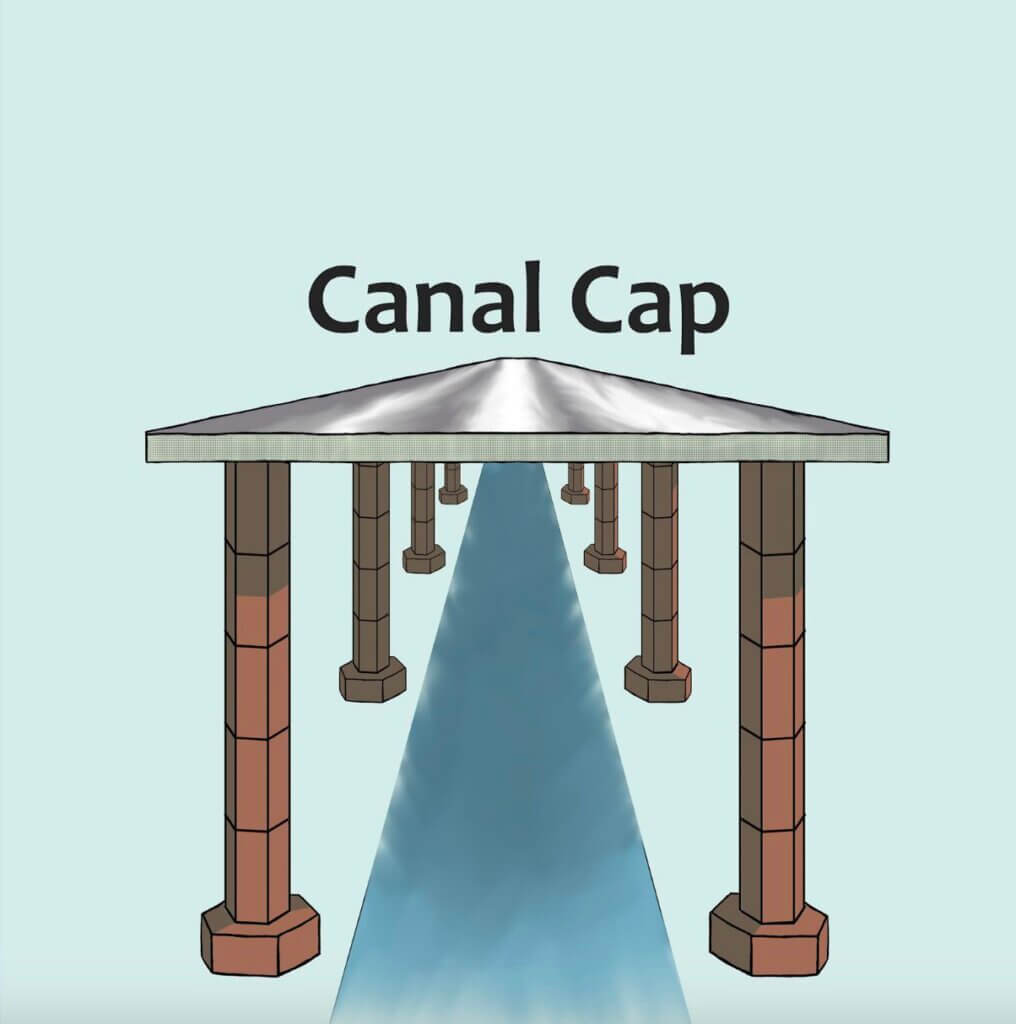
Taking first place, a team of five students from Torrey Pines High School in San Diego, California presented “Canal Cap” with their coach, Julianna Newell. They started by examining their own community in San Diego and found that because of the area’s arid climate, the agriculture industry loses a significant amount of water to evaporation each year. Looking through the lens of SDG Goal 2 (Zero Hunger), the team reasoned that this water loss could potentially inhibit the industry’s ability to produce enough crops to meet demand.
In their initial scoping phase, Team Canal Cap found that previous methods to reduce evaporation involved installing solar panels over irrigation canals. Although effective, this solution can be costly to implement at a large scale. To create a cost-effective alternative, the team settled on designing a reflective, lightweight cover.
The cover, whose surface is modeled after the highly reflective hairs of Saharan silver ants, is also insulated with a layer that mimics the porous structure of cuttlefish bones, reducing additional heat transfer. Supporting the cover beneath are hollow, hexagonal pillars that imitate the structural strengths of bamboo and honeycomb. By pivoting from costly solar panel installations to simple reflective covers, Team Canal Cap exemplifies the Biomimicry Life’s Principle of “Be Resourceful with Materials and Energy” to create an effective, nature-inspired alternative.
Second Place: AI Data Center Cooling
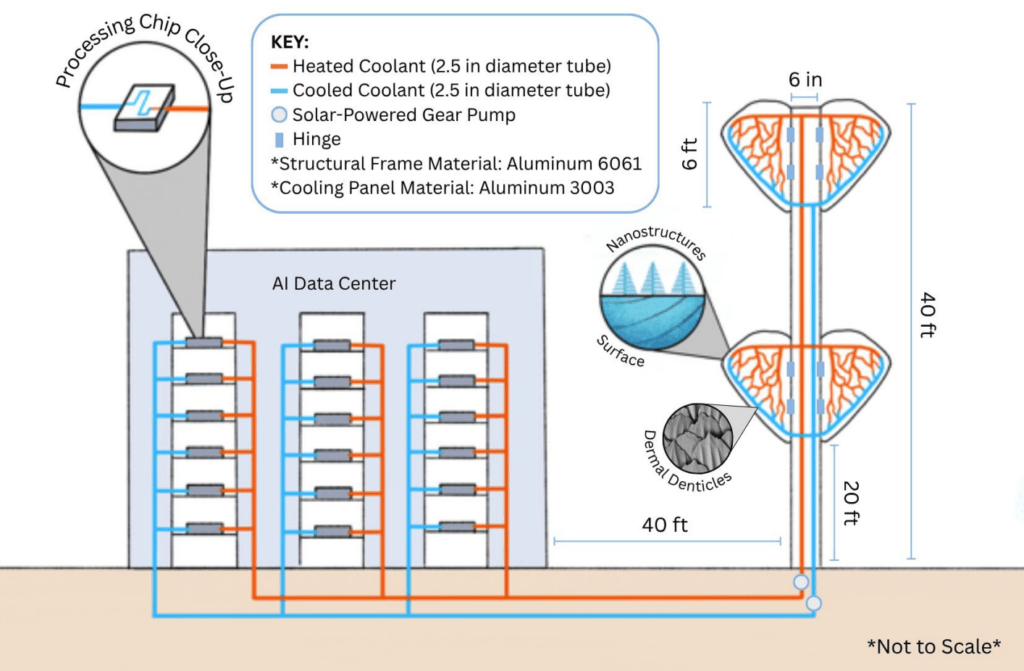
In second place, four students from Hopewell Valley Central High School in North Wales, Pennsylvania and their coach, Nick Johnson, submitted the project “AI Data Center Cooling” to address SDG Goals 12 (Responsible Consumption and Production) and 14 (Life Below Water). With AI usage rising, data centers are producing considerable heat and using large amounts of water to cool their technology. In doing so, the team found that this often contributes to thermal pollution in nearby bodies of water, harming aquatic ecosystems.
Through a new design, the team hoped to optimize data center cooling systems in a way that promotes responsible water consumption and protects aquatic life. Their solution incorporates biological strategies from three distinct organisms: the shortfin mako shark, the African elephant, and the blue morpho butterfly. Emulating how the shortfin mako shark’s skin reduces drag while the shark swims, the project reimagines water flow within the cooling system to ensure cooled water flows around heated processing chips sufficiently.
The remaining two organisms offer inspiration for another way to release thermal energy: into the air. African elephants release body heat through their large ears while blue morpho butterflies have nanostructures on their wings that help them passively regulate temperature. By finding ways to shift thermal pollution from AI data centers away from aquatic ecosystems, this team best shows the Biomimicry Life’s Principle of “Adapt to Changing Conditions.”
Third Place: ThermaFrost
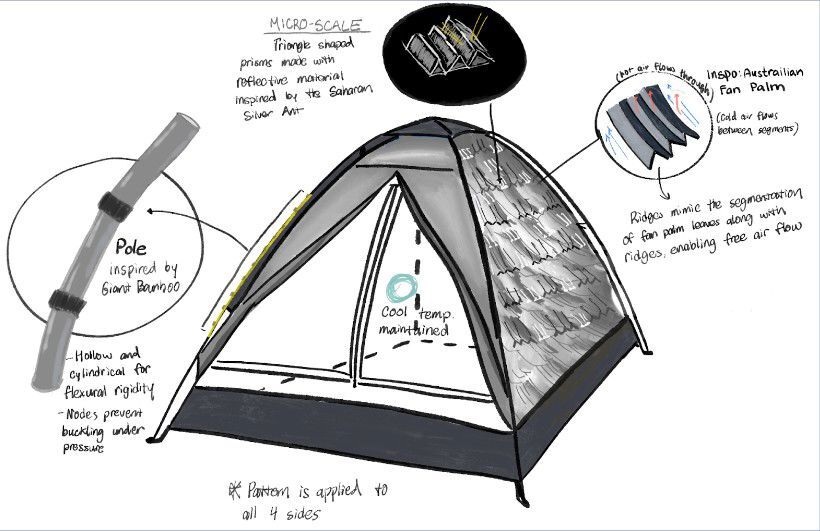
Third place was awarded to the project “ThermaFrost,” another team from Torrey Pines High School in San Diego coached by Julianna Newell. These four high schoolers looked at the increasing risk of hyperthermia due to rising temperatures in the unhoused population of San Diego. To address SDG Goal 3 (Good Health and Well-Being), they designed a tent to improve temperature regulation while also enhancing the essential qualities of a traditional tent.
The tent’s ridged surface takes inspiration from the Australian fan palm whose pleated leaves direct hot air away and bolster wind resistance. The surface dissipates heat further by mimicking the reflective nature of hairs on the Saharan silver ant. To complete the design, the tent poles mimic the form of giant bamboo, preventing the tent from buckling under pressure.
Team ThermaFrost’s solution to SDG Goal 3 is a nature-inspired shelter that protects the unhoused population from rising temperatures, displaying the Biomimicry Life’s Principle of “Be Locally Attuned and Responsive.”
At its core, the Biomimicry Youth Design Challenge encourages participants to explore the challenges within their communities and turn to nature’s genius for innovative solutions–fostering an early understanding of and appreciation for biomimicry.
Katrina He is the Development & Partnerships Manager at The Biomimicry Institute. She is a biomimicry enthusiast and educator dedicated to advancing regenerative and prosocial impact, and she brings a passion for nature-inspired design thinking, along with a background in applied chemistry and sustainability in the built environment. Learn more about Katrina and the rest of the team here.